
Aug 8, 2026Success Stories
How We Developed an Odor-Control Diaper Pail for Global Markets
From DP1 to DP3: how prior-art research, physical odor sealing, standard trash bags and market feedback shaped our diaper pail range.
How We Developed an Odor-Control Diaper Pail for Global Markets
From a Physical Seal to a Complete Product Family: The Story Behind Our DP Diaper Pails
The most important part of a diaper pail is not what can be seen from the outside. It is the barrier between the waste inside the pail and the air in the room.
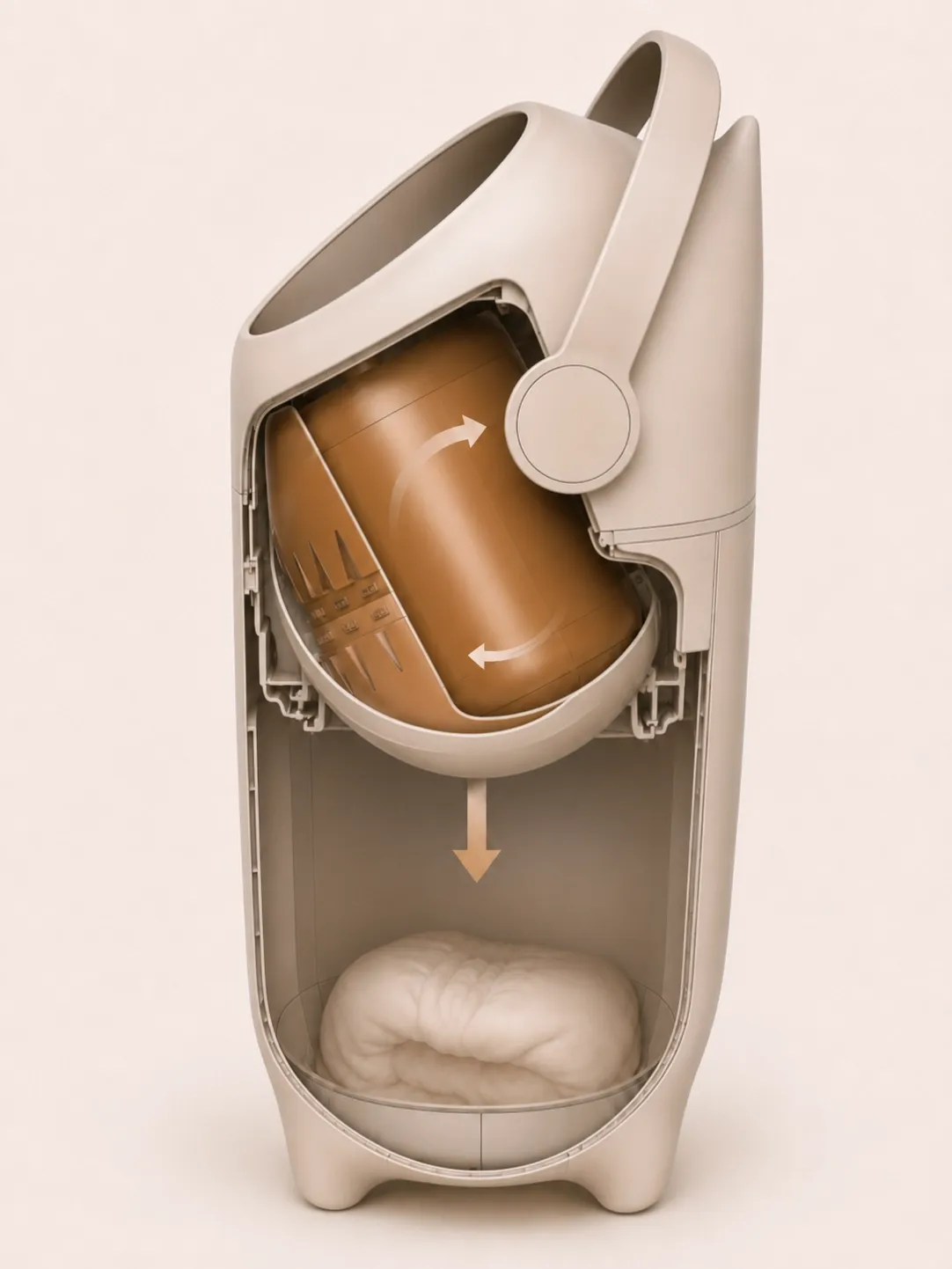
That principle guided the development of our DP diaper pail family. Instead of relying mainly on fragrance, activated carbon or expensive refill cassettes, we focused on a mechanical solution: a rotating ball-shaped chamber that helps create a physical odor barrier at the pail opening.
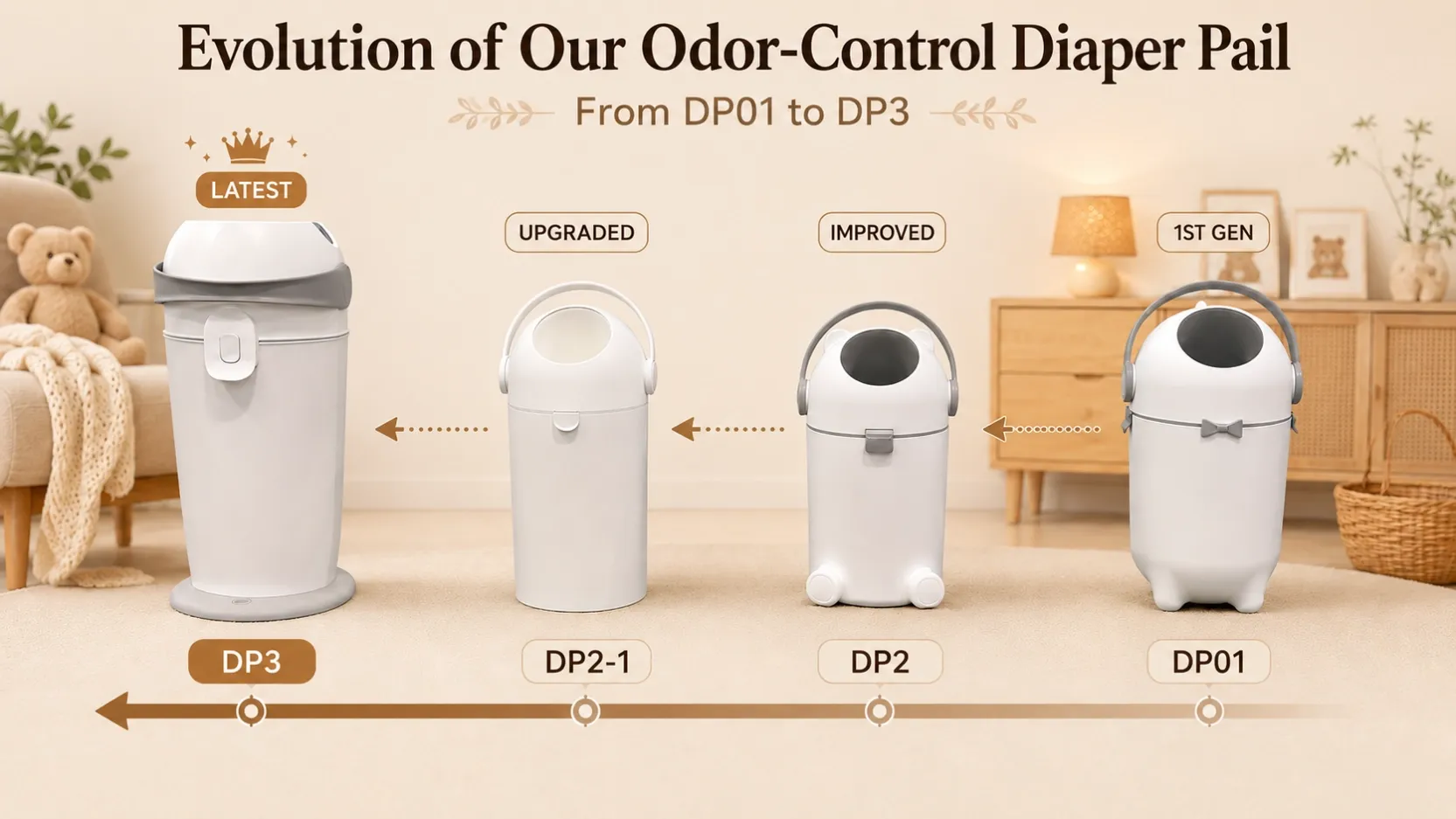
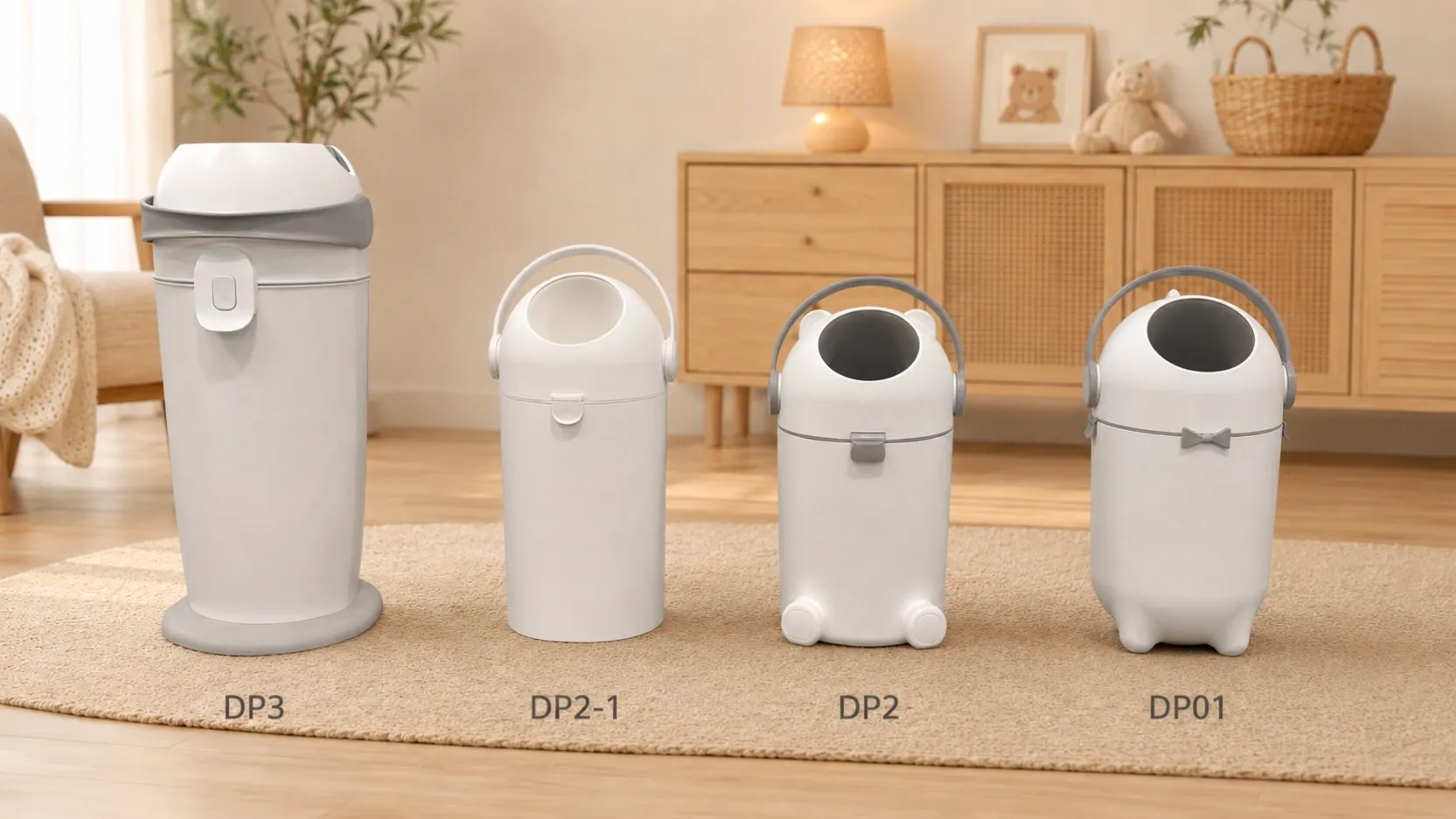
This was not a one-step design project. It began with the study of earlier technology, continued with patent-risk analysis and independent engineering, and then evolved through real feedback from South American, European and North American markets. The result is now a four-model platform: DP1, DP2, DP2-1 and DP3.
How the rotating ball seal works
The operating principle is simple for the user, but the geometry behind it is precise.
- A used diaper is placed into the opening of the rotating chamber.
- The user turns the handle, rotating the chamber toward the inside of the pail.
- The diaper drops into the ordinary garbage bag below.
- As the chamber returns to its resting position, its curved outer surface meets the annular sealing area and closes the main path through which odor could escape.
The chamber therefore works as both a transfer device and a physical valve. The waste passes through only during the turning action; for the rest of the time, the opening remains mechanically separated from the storage area.
For users, this approach brings three practical advantages: there is no electrical system, the mechanism is intuitive, and the pail can work with widely available household garbage bags rather than a proprietary refill cassette.
Learning from prior art - then engineering our own product platform
Rotating odor-control structures are not new. One important early reference is U.S. Patent US 5,651,231, “Valving”, filed in 1994 and granted on July 29, 1997. The document describes a diaper-disposal apparatus in which a rotating drum, internal piston and sealing elements help move a diaper into a container while reducing odor backflow.
Before finalizing our own product, we commissioned a patent search and technical comparison. The review did not stop at US 5,651,231, which the report identified as expired. It also compared our proposed manual structure with later patent families covering features such as powered, sensor-operated movement and a particular flexible seal with a free movable end.
The report concluded that none of the reviewed patent claims was fully reproduced by our analyzed product structure. For example, our design is manually operated rather than sensor-driven, and it uses an annular bag-retaining and sealing structure rather than the specific flexible free-end seal described in another reviewed patent family.
That analysis gave us a clearer engineering boundary. We were not trying to claim that the basic idea of a rotating chamber had never existed. Our work was to turn a known physical principle into a lighter, more compact, manufacturable and market-appropriate product platform - with our own structure, appearance and user-experience improvements.
Why Brazil was the first target market
We first focused on Brazil and the wider South American market because the consumer problem is especially clear there. Warm conditions can make odor management more noticeable, while buyers still need products that fit realistic household budgets.
The demographic picture also shows a large annual customer base. According to Brazil's national statistics agency, IBGE, 2,376,901 births were registered in Brazil in 2024. The World Bank's demographic series estimates a 2024 crude birth rate of 12.133 births per 1,000 people.
It is important to interpret these figures correctly: Brazil's birth rate is declining, not rising. IBGE reported that registered births fell 5.8% from 2023 and that 2024 was the sixth consecutive year of decline. Even so, approximately 2.38 million newborns in a single year still represent one of the largest new-parent cohorts in the region.
A simple demand scenario illustrates the scale. If only 5% of one annual newborn cohort purchased a dedicated diaper pail, that would equal approximately 119,000 units. At 10% adoption, the opportunity would be approximately 238,000 units. These figures are not a sales forecast; they are a transparent scenario based on the 2024 birth cohort and assumed category penetration.
This combination - a substantial annual user base, a clear odor-control problem and strong price sensitivity - shaped the first product in the range.
DP1: bringing physical odor control to a value-conscious market
DP1 was designed as the foundation model. The objective was not to add as many components as possible. It was to retain the core function customers cared about while controlling material use, tooling complexity, packing volume and retail price.
The model combines a compact body, manual rotating chamber, annular sealing area and compatibility with ordinary 10-liter garbage bags. Compared with older, bulkier products built around similar operating ideas, DP1 was designed to be easier to place in a nursery, easier to ship and more suitable for high-volume retail.
Within its first year in the Brazilian market, the design was adopted by established baby-product brands BUBA and Clingo. Their current Brazilian online listings provide visible evidence of consumer acceptance. As of August 2026, the BUBA product listing on Amazon Brazil showed a 4.8-star rating from more than 2,500 reviews, while the Clingo listing showed a 4.8-star rating from more than 700 reviews.
For that reason, we describe DP1 as a leading value-focused anti-odor diaper pail platform in Brazil - a stronger and more verifiable statement than making an unsupported absolute “No. 1” claim.
DP2 and DP2-1: making bag replacement easier
Market success also exposed the next usability issue.
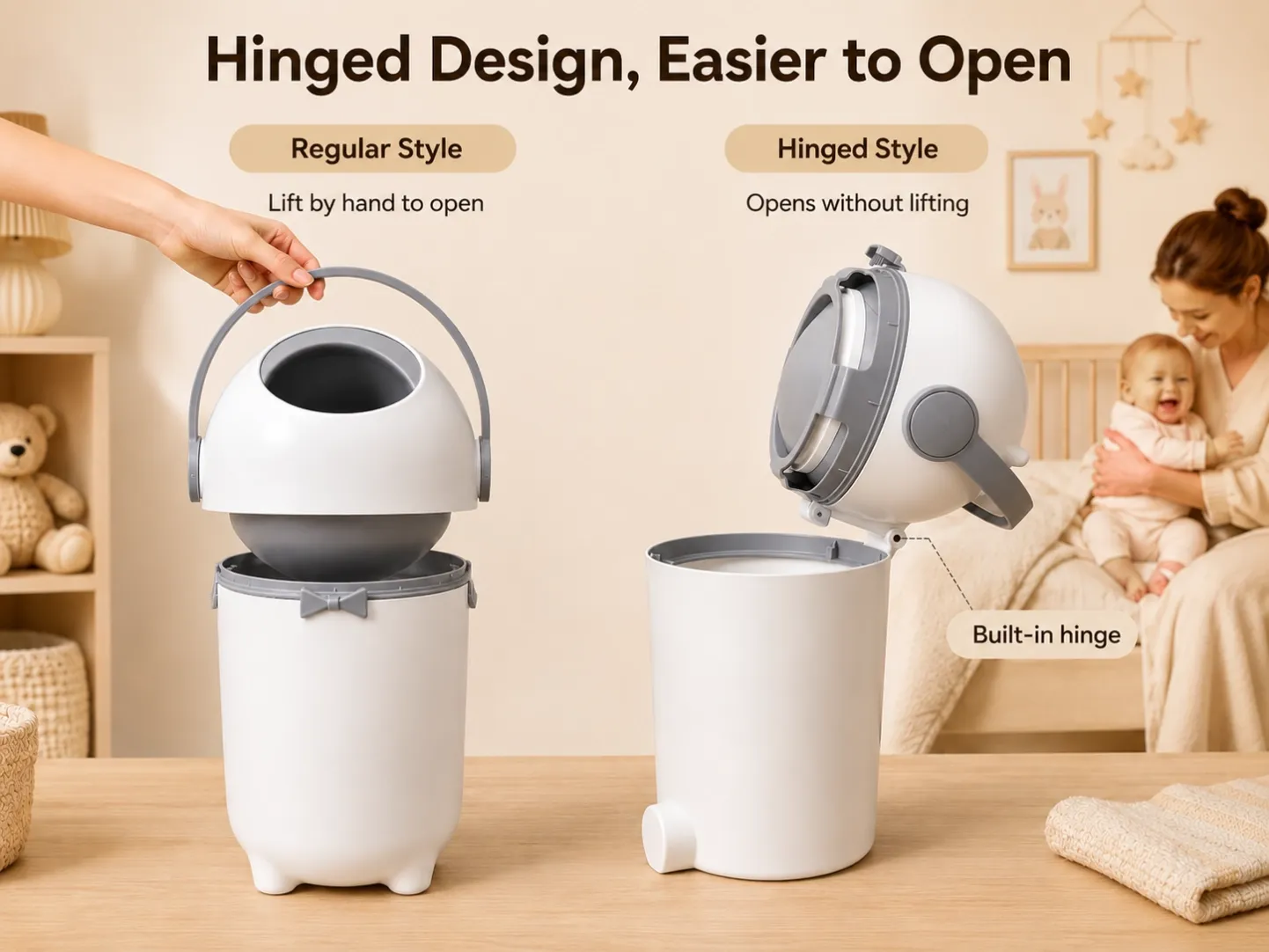
With the original DP1 structure, the complete upper section has to be lifted away from the body when replacing the garbage bag. The operation is not difficult, but it adds an extra handling step and requires the user to place the removed top somewhere temporarily.
For DP2 and DP2-1, we redesigned the opening method. The upper assembly and body are connected by a hinge, so the user can open the pail as one unit and replace the bag without completely removing the head.
This apparently small structural change improves the experience in several ways:
- fewer steps during bag replacement;
- no need to hold or set aside the upper assembly;
- better control when closing the pail after installing a new bag;
- a clearer path for brand-specific exterior customization.
The hinged platform attracted interest from buyers in both Europe and North America. It also supported customized European development, including a Chicco program with a market-specific exterior design. The project confirmed an important lesson: after odor control is solved, convenience during cleaning and bag replacement becomes the next major purchasing factor.
DP3: designed around North American household habits
For North America, we began with a different question: what creates the greatest long-term inconvenience for the user?
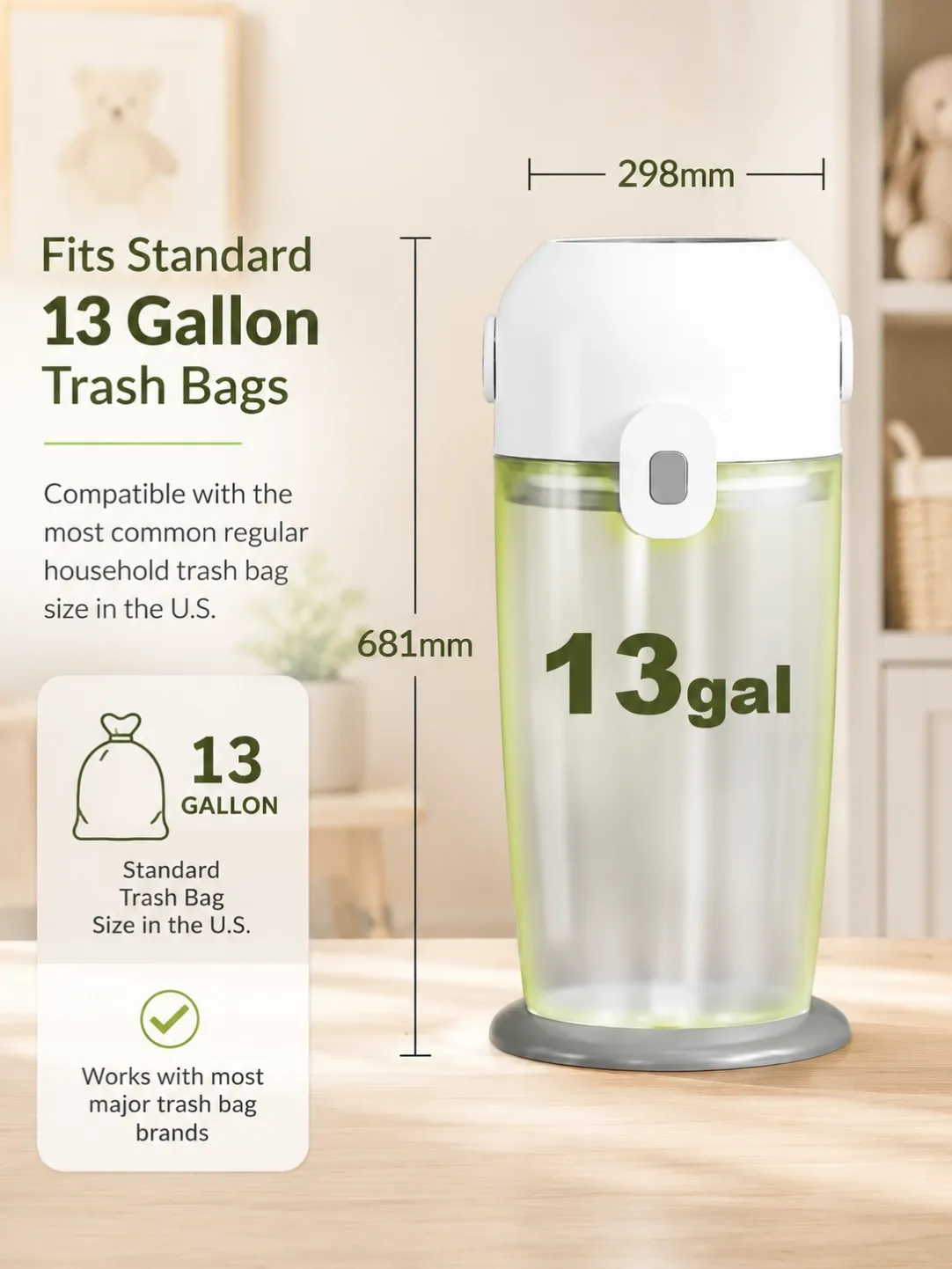
Many diaper disposal systems depend on proprietary refill bags. These can add recurring cost and make the pail less convenient if the correct refill is not immediately available. At the same time, 13-gallon kitchen bags are a familiar household format in the United States.
DP3 was therefore developed around three requirements:
1. Compatibility with 13-gallon household garbage bags
Users are not locked into a special cassette. They can use a familiar bag format that is widely available through supermarkets, warehouse clubs and online retailers.
2. Greater capacity and less frequent bag replacement
The taller body makes better use of the larger liner. This helps reduce how often the bag needs to be changed compared with a compact nursery pail.
3. A 68 cm working height with double odor sealing
At 68 cm high, DP3 reduces repeated bending during everyday use. This makes it relevant not only for parents handling frequent newborn diaper changes, but also for households and care environments dealing with adult incontinence products.
DP3 also advances the odor-control architecture from a single main sealing interface to a double-seal structure. The design aims to improve odor containment both at the rotating disposal chamber and at the connection to the storage body.
DP3 is now in mass production, completing the current evolution from a compact value model to a larger, ergonomic and standard-bag-compatible solution.
One sealing principle, four market-specific solutions
Model | Main market need | Key design response |
|---|---|---|
DP1 | Strong odor control at an accessible cost | Compact rotating-ball structure; ordinary 10 L bag compatibility |
DP2 | Easier bag replacement | Hinged top assembly; no need to remove the complete head |
DP2-1 | Alternative styling on the improved platform | Hinged opening with a customizable exterior architecture |
DP3 | Larger North American bag format and ergonomic use | 13-gallon bag compatibility, 68 cm height, larger capacity and double sealing |
Product development should follow the user, not stop at the first successful model
The DP series shows how we approach product development. We begin with the real problem, study the technical and intellectual-property landscape, build the simplest reliable solution, and then continue improving it through market feedback.
DP1 answered the need for affordable physical odor control. DP2 and DP2-1 simplified bag replacement. DP3 adapted the platform to larger household bags, reduced bending and strengthened the sealing system.
Today, these models give baby-care brands, importers and retailers several starting points for different price levels and regional habits. Appearance, color, packaging and selected functional details can be developed for OEM and ODM programs.
If you are planning an odor-control diaper pail range for South America, Europe or North America,and other countries. contact us to discuss the target price, bag format, capacity, sealing structure and customization direction for your market.