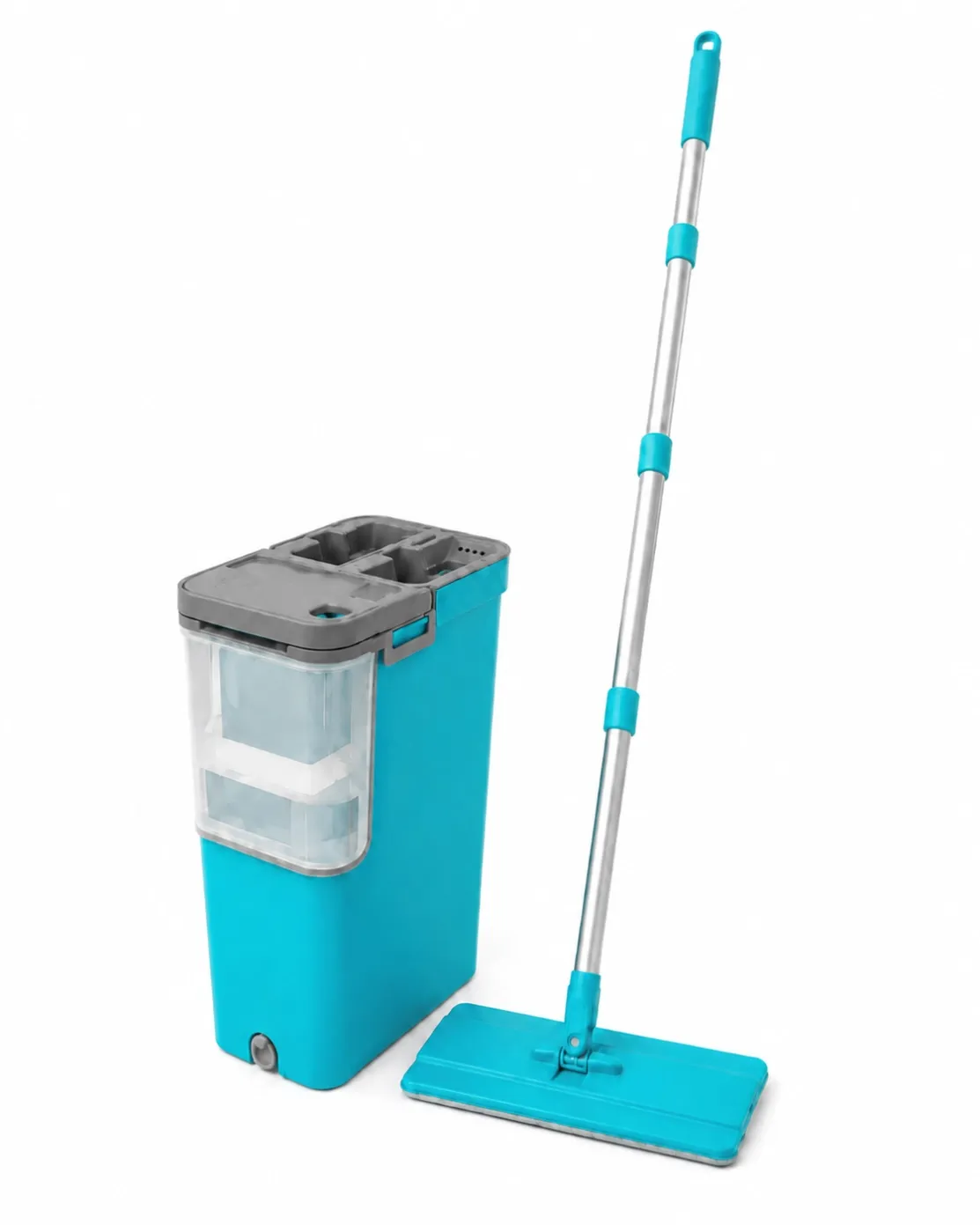
Aug 8, 2026News & Insights
Clean and Dirty Water Separation Mop Systems: Natural Water Flow VS Spray Cleaning
As consumers pay increasing attention to cleaning efficiency and hygiene, clean and dirty water separation mop systems are becoming an important development direction in the household cleaning market.
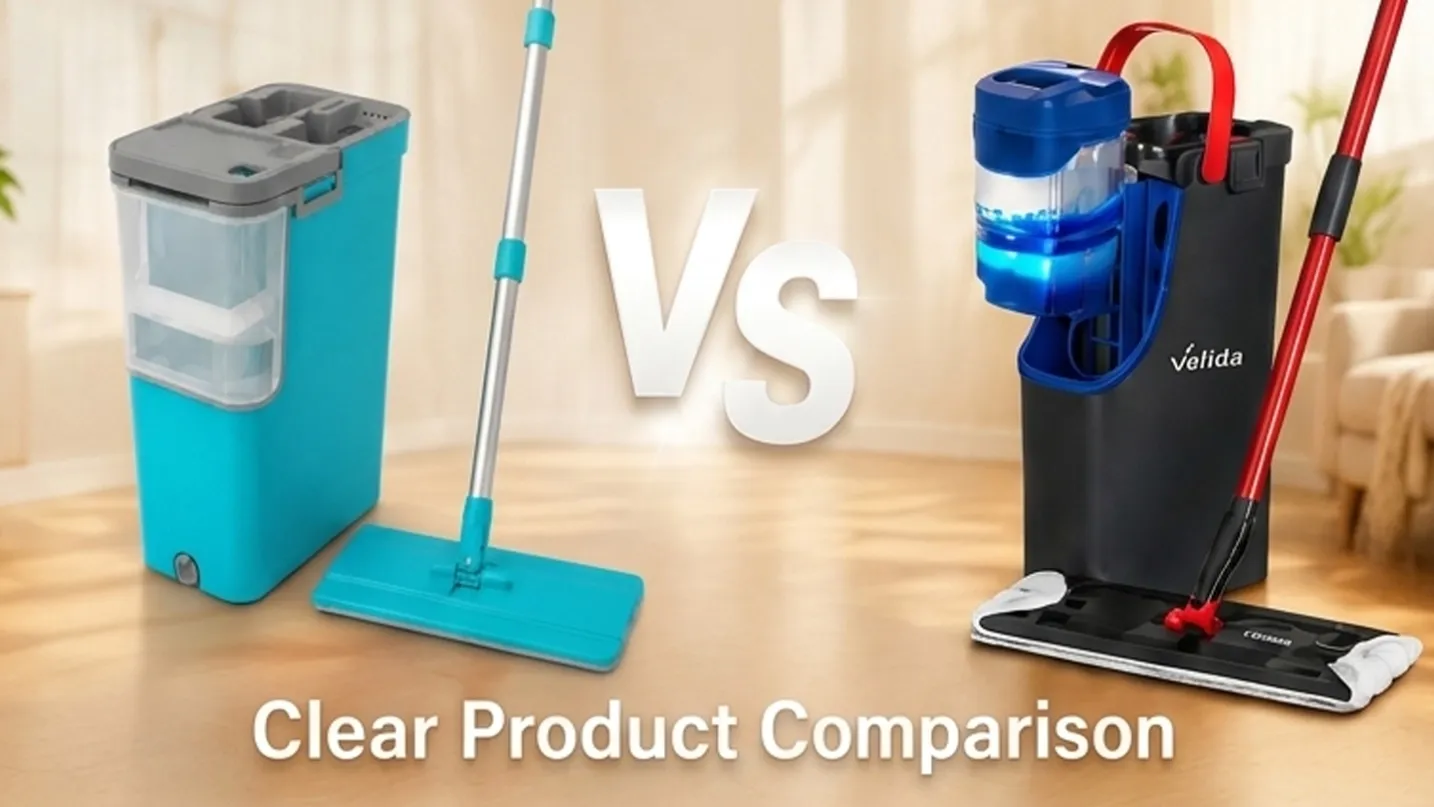
Clean and Dirty Water Separation Mop Systems: Natural Water Flow VS Spray Cleaning
As consumers pay increasing attention to cleaning efficiency and hygiene, clean and dirty water separation mop systems are becoming an important development direction in the household cleaning market.
Unlike traditional mop buckets, these systems are designed to prevent dirty water from repeatedly contaminating the mop pad. However, after reviewing several products currently available on the market, we found that not all clean-water separation systems deliver the same cleaning performance.
Based on the method used to deliver clean water to the mop pad, current products can generally be divided into two main categories:
- Natural water-flow systems
- Spray-based water delivery systems
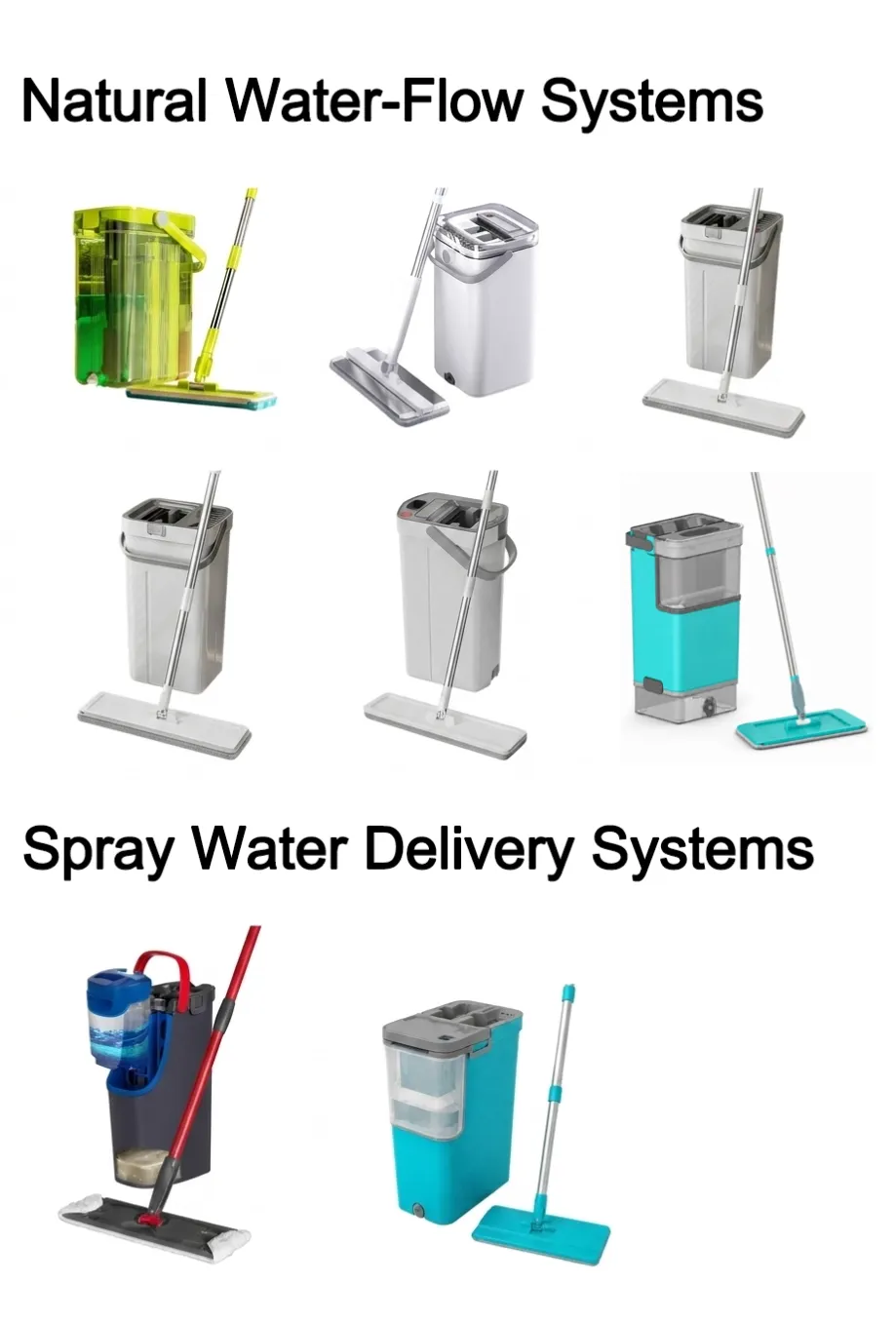
1. Natural Water-Flow Systems
Natural water-flow systems rely mainly on gravity to release clean water from the reservoir.
The structure is relatively simple, and the water can wet the mop pad during the cleaning process. However, simply wetting the pad is not the same as actively washing it.
In many existing designs, the cleaning section cannot use an aggressive scraper or blade structure because certain structural solutions may create patent conflicts in the Chinese market. As a result, some manufacturers use a simplified natural-flow design without an effective scraping or flushing mechanism.
This type of system can generally:
- Add moisture to the mop pad
- Keep the pad from becoming completely dry
- Support basic everyday floor wiping
However, it may be less effective at:
- Flushing dirt out of the mop fibers
- Removing hair and particles from the pad
- Washing away stubborn residue
- Maintaining consistent pad cleanliness during large-area cleaning
In other words, natural water flow mainly wets the mop pad, but it does not always generate enough water pressure to rinse away the dirt trapped inside it.
2. Spray-Based Water Delivery Systems
A spray-based system uses concentrated water jets to distribute clean water directly onto the mop pad.
Compared with natural water flow, spraying produces a more active rinsing effect. The water does not simply flow over the surface of the pad. Instead, it reaches a wider area of the mop cloth with sufficient pressure to loosen and remove accumulated dirt.
The main advantages of spray-based cleaning include:
- Faster and more even pad saturation
- Better removal of dirt from the mop fibers
- More effective rinsing during repeated cleaning cycles
- Improved use of the clean-water supply
- More consistent performance across larger floor areas
During our market research, we found that only a limited number of clean and dirty water separation flat mop systems currently use this spray-based cleaning method.
Among the products we reviewed, Vileda’s comparable system and our newly developed mop both use concentrated water spraying to clean and re-wet the mop pad.
Our Patent-Conscious Structural Design
Developing a spray-based clean-water separation mop is not simply a matter of adding a pump or nozzle.
The complete system involves several important structural elements, including:
- Clean-water storage
- Controlled water delivery
- Mop pad rinsing
- Dirt removal
- Water separation
- Pad wringing
- Sealing and leakage prevention
Our product was developed after reviewing the structural solutions and relevant patent landscape of existing products in the market.
Instead of directly copying an existing design, we created an independent structure intended to avoid the patents identified during our product development and patent review process.
This gives importers, distributors and private-label brands a differentiated product solution while reducing the potential intellectual-property risks associated with directly imitating existing market leaders.
Patent applicability may vary between countries, so market-specific freedom-to-operate verification can also be conducted according to the customer’s target market.
Performance Comparison with the Vileda Benchmark
We conducted an internal comparison between our clean and dirty water separation mop system and the comparable Vileda spray-based system.
The results are summarized below:
Comparison Item | Our Mop System | Vileda Benchmark |
|---|---|---|
Clean-water tank capacity | 1,600 ml | 1,200 ml |
Approximate floor coverage per tank | 100 m² | 60 m² |
Approximate sprays per full tank | 50 sprays | 25 sprays |
Mop-pad saturation cycles | Comparable | Comparable |
Wringing cycles | Comparable | Comparable |
Spray pressure | Comparable | Comparable |
Estimated cost level | Approximately 50% | Benchmark |
The figures above are based on our internal comparative testing. Actual performance may vary depending on flooring type, cleaning method, water consumption, detergent concentration and operating conditions.
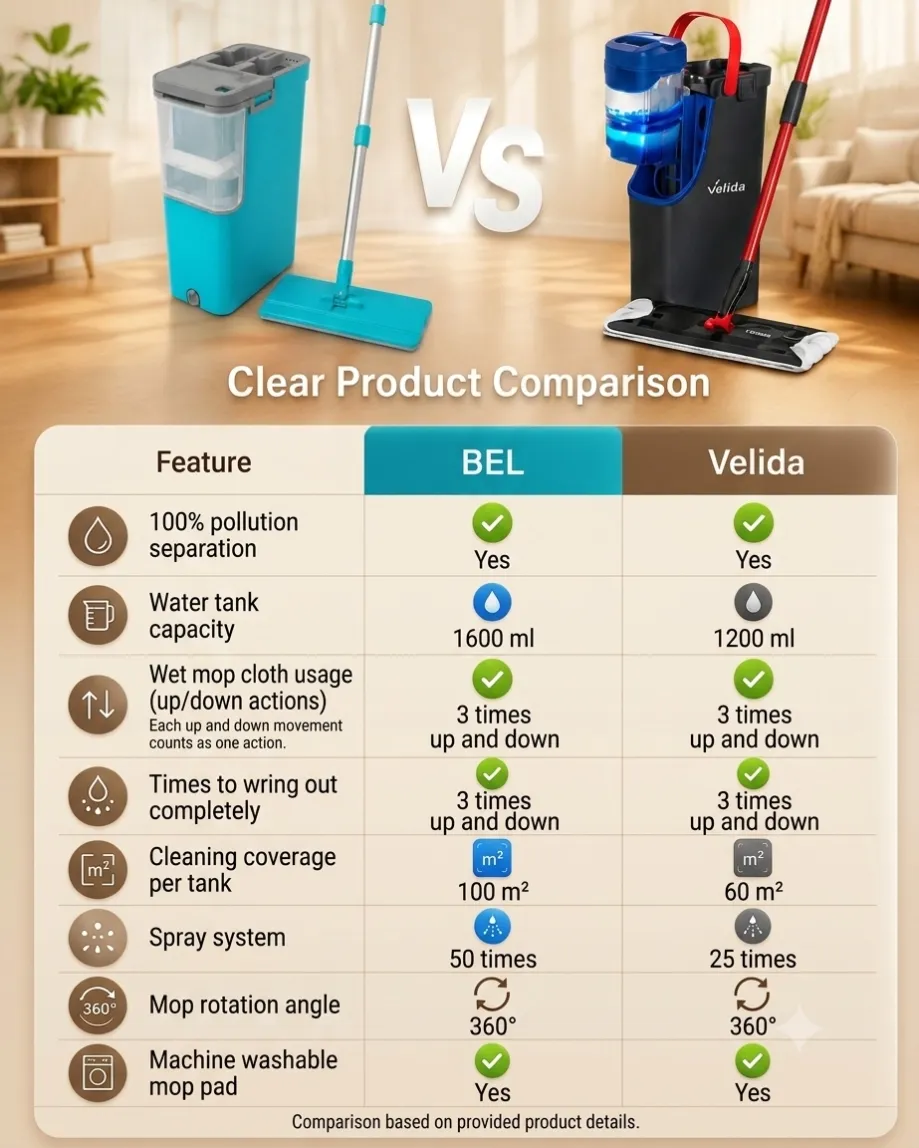
33% Larger Clean-Water Capacity
Our system is equipped with a 1,600 ml clean-water tank, compared with approximately 1,200 ml for the benchmarked Vileda product.
This represents around 33% more clean-water capacity.
A larger water tank provides several practical advantages:
- Less frequent refilling
- Longer continuous cleaning time
- Better suitability for larger homes
- Greater convenience for commercial or professional applications
- More efficient cleaning of multiple rooms with one tank
Although both systems require a similar number of pad-saturation and wringing cycles, the larger reservoir allows our product to clean a significantly larger area before the water needs to be replenished.
Up to 100 m² of Coverage per Tank
According to our internal testing, one full tank can support the cleaning of approximately 100 square meters.
The benchmarked Vileda system covers approximately 60 square meters under comparable test conditions.
This means our system can offer approximately 67% more floor coverage per tank.
For users, this translates into fewer interruptions during cleaning. For retailers and brand owners, it creates a clear and easy-to-communicate consumer benefit:
More cleaning area with one tank of clean water.
Approximately Twice the Number of Sprays
Our system can deliver approximately 50 spray cycles from one full clean-water tank, compared with around 25 spray cycles from the benchmarked system.
Despite the higher number of sprays, the spray pressure remains comparable.
This indicates that the additional cleaning capacity does not come from using a weaker spray. Instead, it is achieved through the combination of:
- A larger clean-water reservoir
- Optimized water consumption
- Efficient nozzle configuration
- Controlled spray output
- Improved internal water management
The result is a product that can rinse the mop pad more frequently while maintaining effective spray performance.
Comparable Cleaning Cycles, Better Water Efficiency
The number of mop-pad saturation cycles and wringing cycles is similar for both systems.
However, our product provides:
- A larger clean-water tank
- More spray cycles
- Greater floor coverage
- Comparable spray pressure
- Comparable cleaning and wringing operation
This means the user does not need to compromise on the basic cleaning process in order to gain additional capacity and coverage.
The system is designed to improve water utilization while maintaining a familiar and convenient operating experience.
A More Cost-Effective Alternative for Private-Label Brands
Performance is only one part of product development. Commercial feasibility is equally important for importers, retailers and private-label brands.
Based on our current product configuration and internal costing, our system can achieve a cost level of approximately half that of the benchmarked Vileda solution.
The final price will depend on factors such as:
- Order quantity
- Product configuration
- Packaging requirements
- Material specifications
- Color customization
- Testing and certification requirements
- Target market
This cost advantage gives customers greater flexibility when planning their retail positioning.
The product can be developed for:
- Mass-market retail programs
- Supermarket and hypermarket channels
- Home-cleaning brands
- E-commerce platforms
- Promotional product programs
- OEM and ODM private-label projects
Conclusion
Clean and dirty water separation is becoming an increasingly important feature in modern floor-cleaning systems. However, the way clean water is delivered to the mop pad directly affects the product’s actual cleaning performance.
Natural water-flow systems offer a simple method of keeping the mop pad wet, but their ability to actively rinse dirt from the pad may be limited.
Spray-based systems provide a stronger and more controlled rinsing effect. They can wet the pad more evenly, loosen dirt more effectively and support repeated cleaning over a larger floor area.
Our newly developed clean and dirty water separation mop combines:
- An independently developed, patent-conscious structure
- A 1,600 ml clean-water tank
- Approximately 50 sprays per tank
- Up to 100 m² of cleaning coverage
- Comparable spray pressure and operating cycles
- A significantly more competitive cost structure
For importers and brands looking for a high-performance alternative to existing premium clean-water separation mop systems, this product offers a strong balance of functionality, differentiation and commercial value.
Looking for a clean and dirty water separation mop for your market?
Contact us for product specifications, samples, OEM/ODM options and a customized quotation.